
Composition with Blue, Yellow, Black, and Red
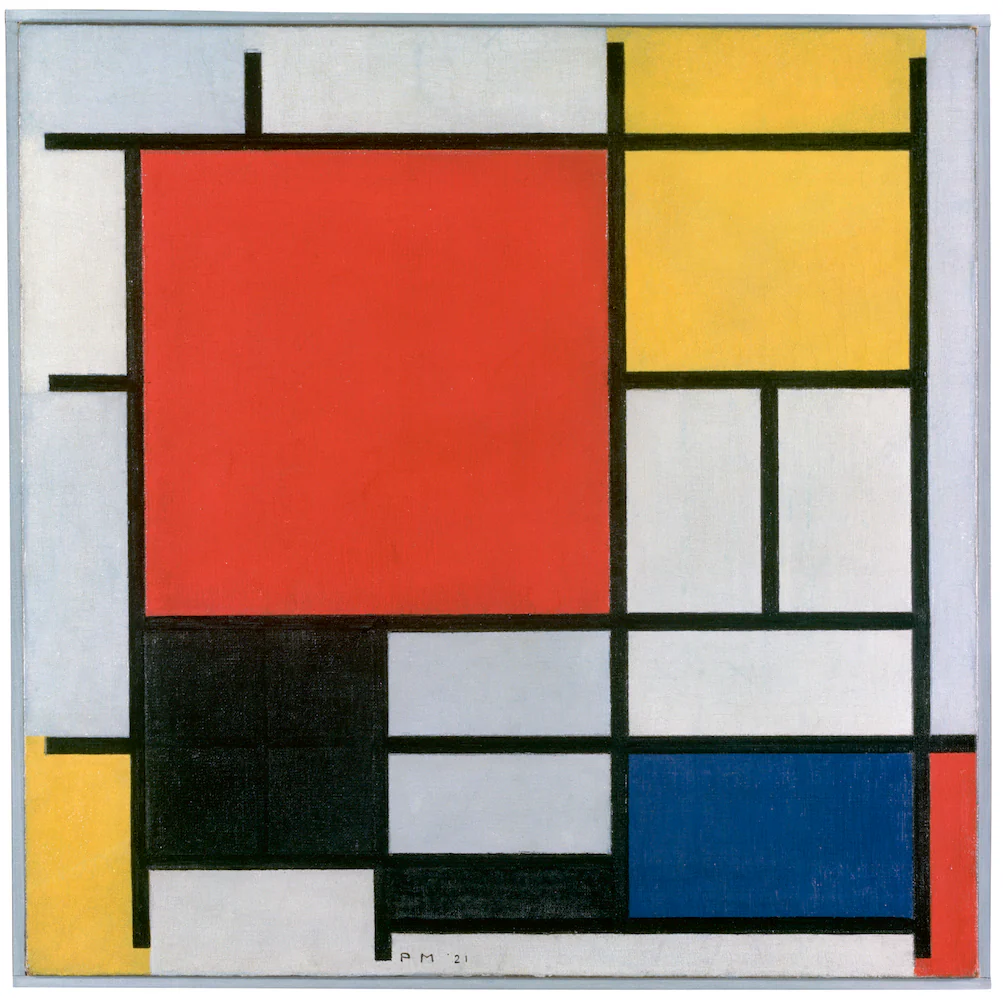
Piet Mondrian, the Dutch artist, crafted paintings characterized by colored squares and rectangles. His compositions were meticulously measured to ensure proportions that were visually appealing. Utilizing a palette of black, white, and select primary colors such as red, blue, and yellow, Mondrian’s work exuded simplicity and harmony.
His paintings served as a profound influence on numerous artists and designers across various creative fields. Mondrian’s innovative concepts found replication in posters, book covers, architectural designs, and even fashion trends. His legacy persists as a testament to the enduring impact of his artistic vision.
Composition in Red, Yellow, Blue, and Black
If you measure the shapes, you’ll discover intriguing proportions. The large red square is half the height and width of the picture frame’s square. The black square is half the height and width of the red square. The white rectangles adjacent to the black square are half its height and resemble two squares combined. The bottom and right sides of the red square align with the golden ratio of the painting.
Key Principles of De Stijl Architecture:
The De Stijl movement, also known as Neoplasticism, significantly influenced architecture by promoting a new aesthetic characterized by abstraction, simplicity, and the use of primary colors along with black and white. Founded in the Netherlands around 1917, the movement included artists, architects, and designers who aimed to create a universal visual language that transcended individual expression.
- Simplicity and Abstraction: De Stijl architecture focuses on stripping down forms to their essential elements. Buildings are designed with simple geometric shapes and clean lines, avoiding decorative details.
- Use of Primary Colors and Neutrals: Following the same principles as in their paintings, De Stijl architects often used primary colors (red, blue, yellow) along with black, white, and gray to define spaces and elements within a structure. This color scheme helped to create visual clarity and harmony.
- Integration of Art and Architecture: De Stijl aimed to eliminate the boundaries between the various arts. Architecture was seen as a total work of art (Gesamtkunstwerk), where every element, from the overall structure to the smallest detail, adhered to the same aesthetic principles.
- Asymmetry and Harmony: De Stijl architecture often features asymmetrical arrangements that still maintain a sense of balance and harmony. This creates dynamic visual compositions within the built environment.
- Open Plan and Flexibility: Interiors of De Stijl buildings frequently incorporate open floor plans with flexible, non-load-bearing partitions, allowing for adaptable spaces that can be reconfigured as needed.
Notable Examples of De Stijl Architecture:
- Rietveld Schröder House (1924): Designed by Gerrit Rietveld in collaboration with Truus Schröder-Schräder, this house in Utrecht, Netherlands, is the most famous example of De Stijl architecture. It features a flexible open plan, use of primary colors, and an innovative design that integrates interior and exterior spaces.
- Van Doesburg House (1930): Designed by Theo van Doesburg, one of the movement’s founders, this house in Meudon, France, reflects De Stijl principles with its geometric forms, primary color palette, and a focus on functionality and simplicity.
- Café de Unie (1925): Originally located in Rotterdam, this café designed by J.J.P. Oud exemplified De Stijl’s principles with its colorful façade and geometric design. Though the original building was destroyed during World War II, a replica was constructed in 1986.
Influence and Legacy:
De Stijl’s impact on architecture extended beyond its active years, influencing later movements such as the Bauhaus and International Style. Key figures like Ludwig Mies van der Rohe and Le Corbusier drew inspiration from De Stijl’s emphasis on simplicity, functionalism, and the integration of art and architecture. The movement’s principles can be seen in modernist and contemporary architecture, emphasizing minimalism, open spaces, and a cohesive visual language.
De Stijl architecture represents a radical departure from traditional architectural design, focusing on purity of form, color, and composition. Its legacy continues to inform and inspire architects and designers around the world.