

Partition walls are a core element of interior design and architecture, allowing spaces to be divided without altering the building’s structural framework. They are non-load-bearing walls designed to create rooms, provide privacy, control sound, and enhance aesthetics — all while allowing flexibility in layout.
In today’s design world, partition walls are not just functional barriers; they are style statements that influence the atmosphere of a space.
Why Use Partition Walls?
- Space Planning: Efficient division of areas without permanent masonry.
- Flexibility: Easy to install, modify, or remove.
- Aesthetics: Can complement interior themes.
- Functionality: Provide privacy, sound control, or light diffusion.
- Services Integration: Can conceal wiring, plumbing, and HVAC ducts.
Popular Partition Wall Materials
Gypsum Board Partitions
Gypsum board partitions are among the most widely used non-load-bearing wall systems in modern interiors. Known for their speed of installation, smooth finish, and design versatility, they have become a standard choice in offices, commercial spaces, and residential projects.
What is a Gypsum Board Partition?
A gypsum board partition is a lightweight wall system made of gypsum panels fixed to a metal (GI) or wooden stud framework. The boards are joined and finished to create a seamless surface, ready for painting, wallpapering, or other decorative treatments.

Construction Details
Basic Components:
- Frame:
- Galvanized Iron (GI) studs and tracks, typically 0.55–0.8 mm thick.
- Stud spacing: 600 mm c/c (closer if higher strength needed).
- Boards:
- Standard thickness: 12 mm.
- Special types: Moisture-resistant (MR) and fire-rated boards.
- Fasteners:
- Drywall screws (25–35 mm) for board fixing.
- Joint Treatment:
- Paper tape or fiber tape with joint compound for smooth finishing.
- Finish:
- Paint, wallpaper, or laminate.
Typical Cross-section:
Advantages
- Lightweight: Reduces dead load on the structure.
- Quick Installation: Faster than brick or block walls.
- Smooth Finish: No plastering required.
- Flexibility: Easy to modify, repair, or relocate.
- Sound & Fire Resistance: Can be enhanced with insulation or special boards.
Limitations
- Moisture Sensitivity: Standard boards absorb water — use MR boards in wet areas.
- Impact Resistance: Lower than masonry walls.
- Hollow Sound: Unless insulation is added.
Best Applications
- Office cabins and meeting rooms.
- Hotel room dividers.
- Residential internal walls.
- Temporary partitions in exhibitions or retail spaces.
Tips for Interior Designers
- Specify MR gypsum boards in kitchens, bathrooms, or utility rooms.
- For acoustic performance, add glass wool or mineral wool in the stud cavity.
- Use corner beads for clean and durable external corners.
- Combine with glass panels for light flow while maintaining privacy.
Glass Partitions: Light, Elegance, and Transparency in Space Design
Glass partitions are a popular choice in modern interiors for their ability to create open, bright, and sophisticated spaces without sacrificing functionality. They’re widely used in offices, retail outlets, hospitality spaces, and increasingly in residential interiors.
What is a Glass Partition?
A glass partition is a non-load-bearing wall made from toughened or laminated glass panels, either framed or frameless. It serves as a physical barrier while maintaining visual connectivity and allowing natural light to pass through.
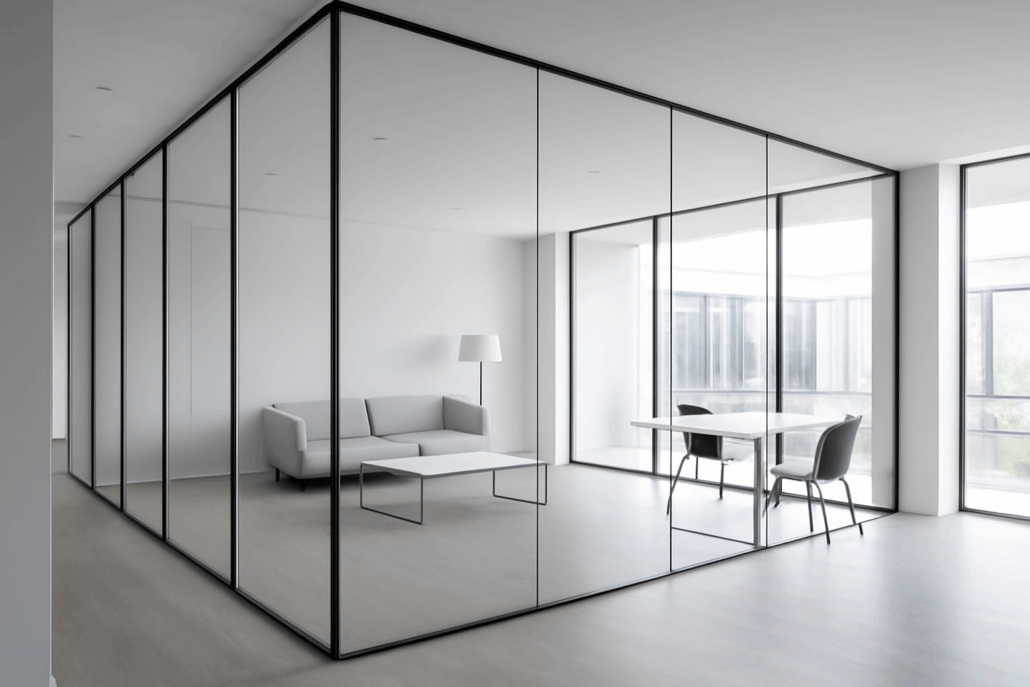
Types of Glass Partitions
1. Frameless Glass Partitions
- Made from toughened glass (8–12 mm thick).
- Fixed using U-channels, patch fittings, or spider fittings.
- Provides a clean, minimal look.
2. Framed Glass Partitions
- Uses aluminum, steel, or wooden frames.
- Can combine glass with other materials (wood, ACP, boards).
- Offers more stability and design variations.
3. Frosted or Etched Glass Partitions
- Surface treatment adds privacy while still diffusing light.
- Can be full-frosted or patterned.
4. Laminated Acoustic Glass
- Two glass sheets bonded with an acoustic PVB layer.
- Reduces sound transmission in offices and meeting rooms.
Construction Details
Typical Components:
- Glass Type: Tempered (safety) or laminated (safety + sound).
- Thickness: 8–12 mm for frameless, 5–8 mm for framed.
- Fixing:
- Frameless: U-channel at floor & ceiling with gaskets.
- Framed: Aluminum/steel profiles with neoprene gaskets.
- Door Options: Frameless glass doors with patch fittings, or framed swing/sliding doors.
- Sealants & Gaskets: Rubber or silicone to hold glass securely and reduce vibration.
Advantages
- Natural Light: Maximizes daylight penetration.
- Modern Aesthetic: Sleek, minimal, and premium look.
- Space Perception: Makes small areas appear larger.
- Customizable: Choice of clear, tinted, frosted, or printed glass.
Limitations
- Privacy: Clear glass offers little privacy unless treated.
- Maintenance: Shows fingerprints, dust, and smudges easily.
- Cost: Higher upfront cost compared to drywall partitions.
- Safety: Requires proper toughening/lamination for safety compliance.
Best Applications
- Office cabins and meeting rooms.
- Retail store displays.
- Hotel lobbies and corridors.
- Residential living-dining dividers.
Design Tips
- Use frosted strips at eye level for privacy without blocking light.
- Combine with blinds or switchable smart glass for adaptable transparency.
- For acoustic needs, opt for double-glazed partitions with air gap.
- Use black or metallic framing for an industrial or modern look.