

The Indian Standard IS 383:2016 “Coarse and Fine Aggregate for Concrete – Specification,” provides detailed guidelines for the quality and grading of aggregates, including Manufactured Sand (M Sand) and Plastering Sand (P Sand), used in concrete and plastering applications. Below is a concise overview of the specifications relevant to M Sand and P Sand as per IS 383:2016 .
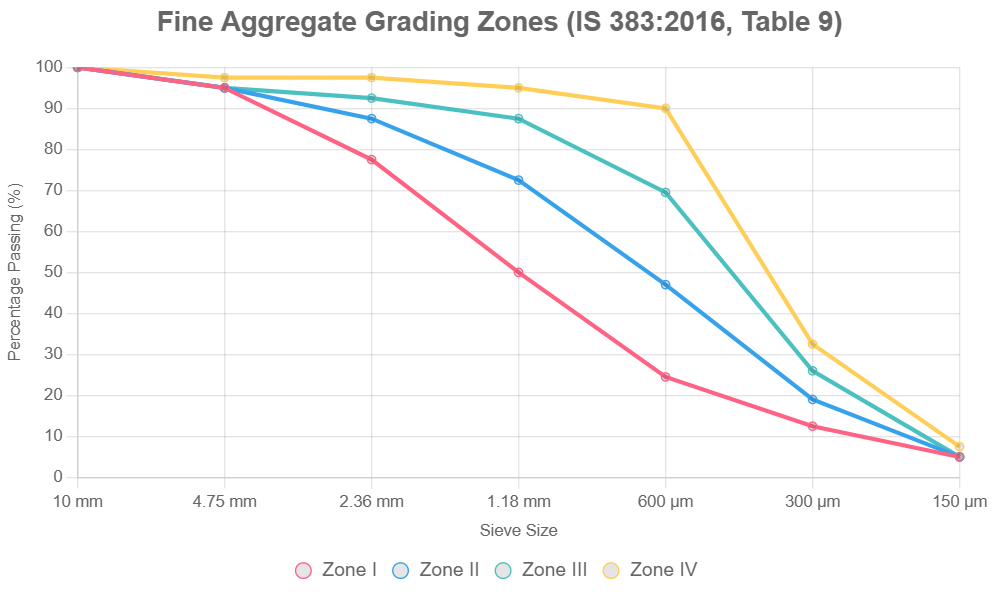
Table 9 of IS 383:2016, which specifies the percentage passing requirements for fine aggregates across different Grading Zones (I to IV) as per Clause 6.3.
Table 9: Fine Aggregates (Clause 6.3) – Percentage Passing Requirements
| SI No. | IS Sieve Designation | Grading Zone I | Grading Zone II | Grading Zone III | Grading Zone IV |
|---|---|---|---|---|---|
| i) | 10 mm | 100 | 100 | 100 | 100 |
| ii) | 4.75 mm | 90–100 | 90–100 | 90–100 | 95–100 |
| iii) | 2.36 mm | 60–95 | 75–100 | 85–100 | 95–100 |
| iv) | 1.18 mm | 30–70 | 55–90 | 75–100 | 90–100 |
| v) | 600 µm | 15–34 | 35–59 | 60–79 | 80–100 |
| vi) | 300 µm | 5–20 | 8–30 | 12–40 | 15–50 |
| vii) | 150 µm | 0–10 | 0–10 | 0–10 | 0–15 |
Notes :
Crushed Stone Sands:
The permissible limit on the 150 µm IS Sieve is increased to 20% for crushed stone sands (e.g., M Sand). This does not affect the 5% allowance permitted for other sieve sizes as per Clause 6.3.
Suitability for Concrete:
Fine aggregates complying with any grading zone in this table are suitable for concrete. However, the quality of the concrete depends on factors like mix proportions, particle shape, and surface texture.
Fine to Coarse Aggregate Ratio:
As the fine aggregate grading becomes finer (from Zone I to Zone IV), the ratio of fine aggregate to coarse aggregate should be progressively reduced. The optimal ratio depends on the actual grading, particle shape, and surface texture of both fine and coarse aggregates.
Grading Zone IV Restriction:
Fine aggregates conforming to Grading Zone IV are not recommended for reinforced concrete unless tests confirm the suitability of the proposed mix proportions.
M Sand (Manufactured Sand) Specifications
M Sand is a fine aggregate produced by crushing hard stone or other materials, used as a substitute for natural river sand in concrete and other construction applications.
- Definition:
- M Sand is defined as fine aggregate manufactured from sources other than natural disintegration of rock, typically by crushing hard stone or through other processes like thermal or mechanical means.
- It must be free from adherent coatings, hard, durable, clean, and should not contain excessive clay, impurities (e.g., iron pyrites, alkalis, salts, coal, mica, shale), or other deleterious materials beyond the specified limits.
- Grading Zones:
- As per IS 383:2016, fine aggregates (including M Sand) are classified into four grading zones (Zone I to Zone IV) based on particle size distribution and silt content.
- Zone I: Coarser, higher silt content; suitable for non-reinforced concrete, mass concrete, or filling purposes.
- Zone II: Finer than Zone I, lower silt content; most commonly used for reinforced concrete, plastering, and finishing works due to good workability.
- Zone III: Finer than Zone II, even lower silt content; ideal for reinforced concrete and high-quality plastering/finishing.
- Zone IV: Finest, lowest silt content; used for specialized applications like precast concrete, high-strength, or high-performance concrete.
- Sieve analysis is conducted using standard sieves (e.g., 4.75 mm, 2.36 mm, 1.18 mm, 600 µm, 300 µm, 150 µm) to determine the gradation.
- As per IS 383:2016, fine aggregates (including M Sand) are classified into four grading zones (Zone I to Zone IV) based on particle size distribution and silt content.
- Quality Requirements:
- Deleterious Materials: Limits are specified for materials like clay lumps, mica, and shale. For example, mica content should be minimized as it adversely affects workability and strength. The maximum limits for deleterious materials are outlined in Table 2 of IS 383:2016.
- Physical Properties:
- Specific Gravity, Water Absorption, and Bulk Density: Must be tested to ensure mix design compatibility and durability.
- Shape: Preferably angular or cubical to enhance bonding with cement; rounded particles may reduce bond strength.
- Alkali-Aggregate Reactivity: Aggregates should not react adversely with cement, as this can cause cracking.
- Testing: Sieve analysis, abrasion tests, water absorption tests, and checks for organic impurities are mandated to verify quality.
- Utilization:
- M Sand is permitted for use in plain and reinforced concrete, with specific utilization limits for manufactured aggregates as outlined in Table 7, Table 8, and Table 9 of IS 383:2016. It is not permitted in prestressed concrete.
- Recycled aggregates (e.g., from construction and demolition waste) can be used as M Sand, provided they meet the grading and quality requirements.
- Manufacturing Process:
P Sand (Plastering Sand) Specifications
P Sand is a finer type of manufactured sand specifically used for plastering and finishing works, characterized by its smooth texture and lower silt content.
- Definition:
- P Sand is not explicitly defined in IS 383:2016 as a separate category but is considered a fine aggregate tailored for plastering, typically falling under Zone III or Zone IV due to its finer gradation and low silt content.
- It is produced similarly to M Sand but processed to achieve a finer particle size suitable for smooth plastering and finishing applications.
- Grading Zones:
- Quality Requirements:
- Similar to M Sand, P Sand must be clean, hard, durable, and free from excessive deleterious materials (e.g., clay, silt, organic impurities).
- The finer gradation ensures better workability and a smoother finish for plastering applications.
- Limits on mica and other impurities are critical, as they can affect the adhesion and finish quality of plaster.
- Utilization:
Key Differences Between M Sand and P Sand
| Aspect | M Sand | P Sand |
|---|---|---|
| Purpose | Used for concrete, masonry, and general construction. | Specifically used for plastering and finishing works. |
| Grading Zone | Typically Zone I or II for concrete; can be Zone III/IV for specific uses. | Usually Zone III or IV for smoother plastering. |
| Particle Size | Coarser (suitable for concrete strength). | Finer (suitable for smooth plaster finish). |
| Silt Content | May have slightly higher silt content (Zone I/II). | Lower silt content (Zone III/IV) for better finish. |
| Applications | Reinforced/non-reinforced concrete, masonry, flooring. | Plastering, rendering, wall finishing. |
Additional Notes
- Amendments: IS 383:2016 includes amendments (e.g., Amendment No. 2, November 2019) that add requirements for aggregates used in high-velocity water environments (flow velocity > 6 m/s), applicable to both M Sand and P Sand.
- Testing Standards: Tests for aggregates are conducted per IS 2386 (Parts 1–8), covering sieve analysis, mechanical properties (e.g., flakiness, elongation), and chemical properties (e.g., alkali reactivity).
- Sustainability: IS 383:2016 allows the use of aggregates from non-natural sources, such as recycled aggregates and copper slag, to address shortages of natural aggregates, provided they meet quality requirements.
FD Forum Threads
Disclaimer
Information on this site is purely for education purpose. The materials used and displayed on the Sites, including text, photographs, graphics, illustrations and artwork, video, music and sound, and names, logos, IS Codes, are copyrighted items of respective owners. Front Desk is not responsible and liable for information shared abov