

Staircase Design and Construction
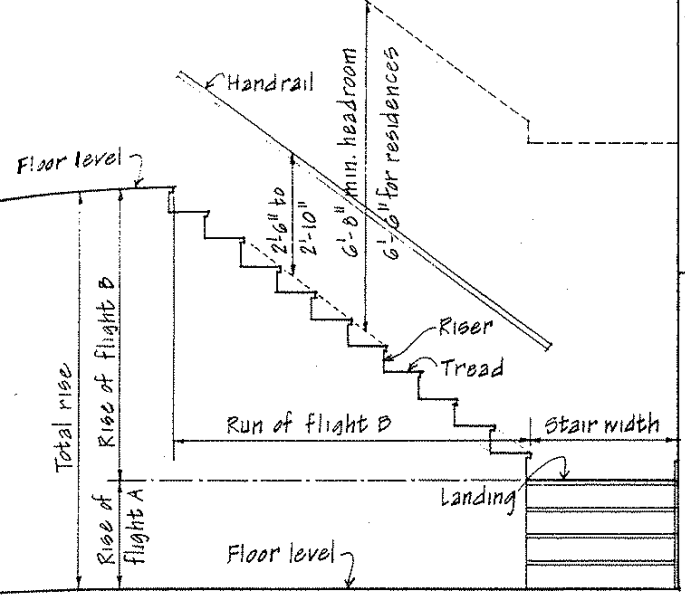
To design or understand staircases accurately, it is essential to be familiar with the technical terms used in their construction. Each component serves a specific structural and functional purpose, ensuring comfort, safety, and stability.
1. Step
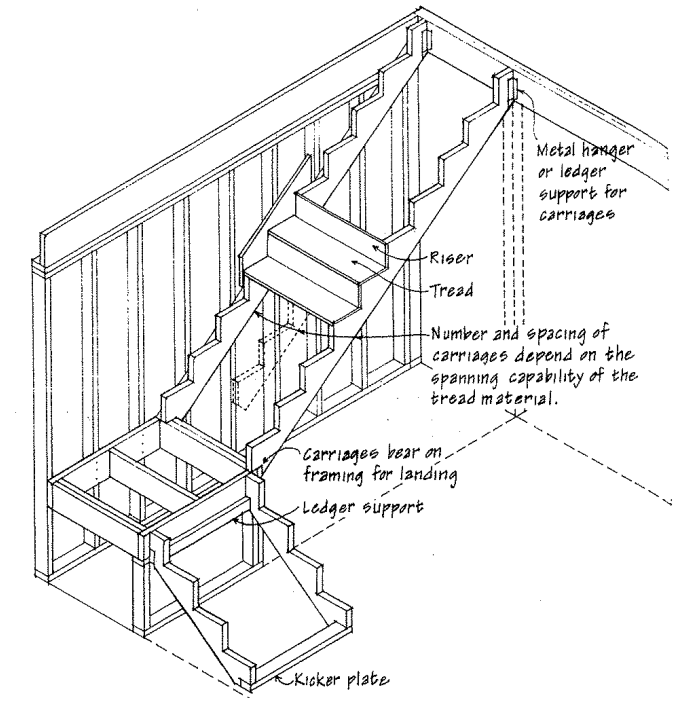
A single combination of a tread and a riser, forming one unit of a stair.
2. Tread
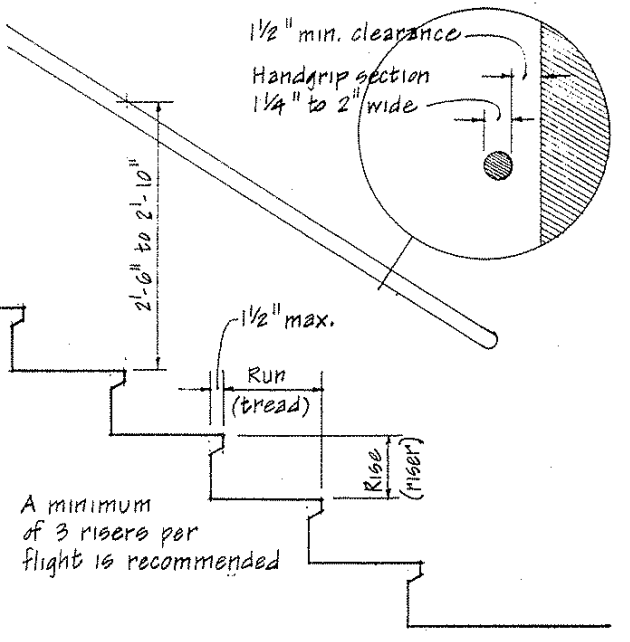
The horizontal top surface of a step on which the foot is placed while ascending or descending.
- Typical size: 250–300 mm.
3. Riser
The vertical face between two consecutive treads.
- Typical size: 150–180 mm.
- Open risers (without vertical boards) are used in modern or light structures.
4. Nosing
The front projecting edge of a tread beyond the face of the riser.
- It provides additional foot space and enhances safety and appearance.
5. Rise
The vertical height between two consecutive treads or between floors.
- The total rise = floor-to-floor height.
6. Going
The horizontal distance between the faces of two consecutive risers.
- In a straight stair, it equals the tread depth (excluding nosing projection).
7. Flight
A series of uninterrupted steps between two landings.
8. Landing
A horizontal platform between two flights or at the top/bottom of a staircase.
- It provides rest and facilitates change in direction.
9. Pitch or Slope
The angle of inclination of the staircase to the horizontal.
- Comfortable pitch: 25°–35°.
10. Headroom
The vertical clear distance between the tread and the ceiling or structure above it.
- Minimum requirement: 2.1 m (2100 mm).
11. Stringer (or String)
The inclined structural member that supports the treads and risers on each side.
- Types:
- Closed string – covers the ends of treads and risers.
- Open string – shows the profile of the steps.
12. Newel / Newel Post
A large vertical post at the start, end, or turning point of a stair that supports the handrail and string.
13. Handrail
A continuous rail fixed parallel to the slope of the stair, provided for user support and safety.
14. Baluster
A vertical member (circular or rectangular) supporting the handrail.
- Also acts as a safety barrier to prevent falls.
15. Balustrade
The complete assembly of handrail, balusters, and base rail forming the side protection of a staircase.
16. Baserail
The bottom rail fixed along the top of the string or landing on which the balusters stand.
17. Newel Cap
The decorative top element placed on the newel post.
18. Bullnose Step
The first step of a staircase with one or both ends rounded for a decorative appearance.
19. Curtail Step
The bottom step of a staircase where the tread is curved or scrolled, often supporting a newel post.
20. Winder
A tapered step used to change the direction of the stair without a landing.
21. Stairwell
The vertical shaft or open space in which a staircase is located.
22. Stair Width
The clear horizontal distance between the two strings or handrails.
23. Continuous Handrail
A handrail that runs smoothly over newels and landings without interruption, ensuring safety and aesthetic flow.
24. Balustrading Height
The minimum height of the balustrade or handrail, generally 900–1000 mm above the pitch line.
Summary Table
| Term | Meaning / Function |
|---|---|
| Tread | Horizontal step surface |
| Riser | Vertical face between treads |
| Nosing | Projecting front edge of tread |
| Flight | Series of steps between landings |
| Landing | Rest platform |
| Stringer | Support beam for treads/risers |
| Newel Post | Main supporting post |
| Handrail | Support rail for users |
| Baluster | Vertical support for handrail |
| Balustrade | Entire protective assembly |
| Headroom | Vertical clearance above steps |
Staircase Design and Construction
Staircase Terminology | Types of Staircases | Functions and Importance