

Jaipur – UNESCO World Heritage City
Hawa Mahal – The Palace of Winds
The most celebrated addition came under Pratap Singh (1778–1803), grandson of the founder. Unlike his troubled predecessors, Pratap Singh revived Jaipur’s cultural and architectural patronage. His most famous commission, completed in 1799, was the Hawa Mahal.
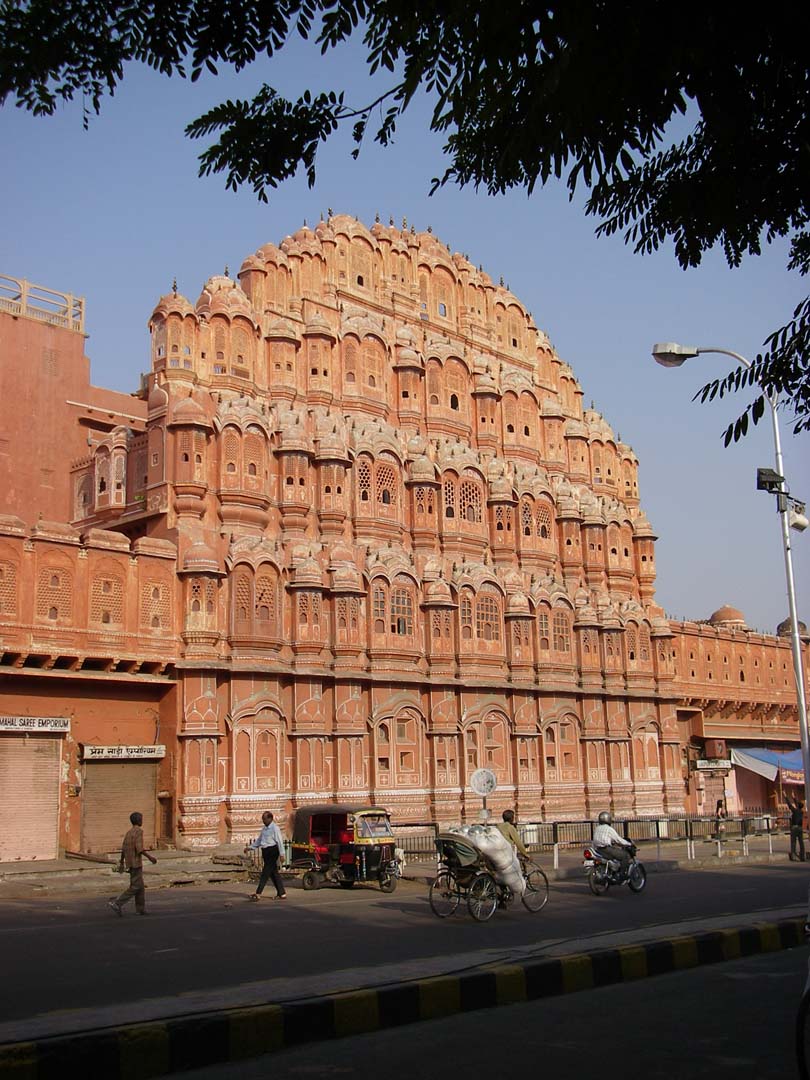
Designed by architect Lal Chand Ustad, the Hawa Mahal rises like a honeycomb of red and pink sandstone at the southeastern edge of the palace complex. Contrary to the idea that it is merely a screen, the Hawa Mahal is a full structure with two courtyards, though its eastern façade is its most striking feature.
With 953 jharokhas (latticed windows) arranged in tiered symmetry, it allowed the women of the royal household to observe festivals, processions, and bazaars below without being seen themselves. The design combines strict geometric order with visual exuberance—appearing whimsical at first glance, but in fact governed by principles of vastu and varna vidya (traditional science of design).
The Hawa Mahal epitomizes Jaipur’s unique architectural language: functional yet ornamental, private yet public, traditional yet innovative.
The Design Principles of the Hawa Mahal
The Hawa Mahal’s fame lies not only in its romantic symbolism as the “Palace of Winds” but also in the sophisticated design grammar that governs its façade. What appears at first sight to be a whimsical, lace-like screen is in fact a carefully constructed composition rooted in traditional Indian architectural principles.
The Triple-Bayed Motif
Running down the central vertical spine of the façade is a repeated triple-bayed opening. This form is a simplification of a well-known Rajput pavilion type, seen for example in the Mukut Mandir atop the Chandra Mahal. There, two square domed chhatris flank a rectangular chhatri with a curved bangaldar (arched) roof.
On the Hawa Mahal, these elements are reduced and fused into a triple-window motif, giving rhythm to the vertical core of the façade.
Framing Motifs and Octagonal Turrets
Flanking this central motif are smaller groupings, again expressed as three-part openings, but this time set within octagonal turrets topped by round domes. This repetition of threes is a deeply ingrained Indian design principle, where the central part is usually the widest, symbolizing balance and hierarchy.
Rhythmic Composition Across the Façade
If we label the central motif as “A” and the flanking motif as “b”, the façade follows a repeated rhythm of:
Abb Ab Ab Abb ab
This sequence groups itself naturally into larger tripartite divisions:
- “bab – bAbAbAb – bab”
Here, the centre becomes the widest and most elaborate zone, containing three “A” motifs, while the flanking sections are narrower but emphasized by repeated “b” elements.
Vertical Repetition and Crown
This tripartite rhythm is repeated vertically across three storeys, creating a strong sense of harmony and order. The façade is crowned by two additional storeys, necessary to give the structure a proper top and to keep its height lower than the seven-storeyed Chandra Mahal.
The fourth storey continues the same pattern, but with slight height variations to accommodate the curved skyline of the fifth, whose sweeping outline echoes the bangaldar roof form found in the central motif.
In hawa mahal jaipur larger opening in west side and small opening in east side , this strategy receive north west side wind into the building , we always feel the breeze
The design of Hawa Mahal in Jaipur is based on the principle of cross-ventilation, which is a fundamental concept in fluid mechanics. Cross-ventilation relies on the pressure differences created by the movement of air molecules. When air molecules are heated, they expand and become less dense, causing them to rise. This creates an area of low pressure at the top of a building, which draws in cooler air from outside. This process is known as convection.
The design of Hawa Mahal takes advantage of this natural process by creating a series of openings on the western side of the building, which allow cooler air to flow in from outside. The smaller openings on the eastern side of the building help to regulate the flow of air and maintain a comfortable temperature inside the building.
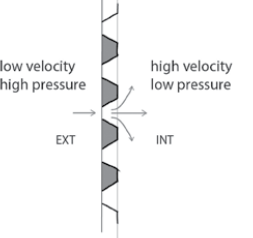
Hawa Mahal was designed with a series of windows and openings on the western side of the building, which allow air to flow into the palace. As the air flows through these openings, its speed increases due to the narrow openings, and according to Bernoulli’s principle, its pressure decreases. This creates a low-pressure zone inside the building, which draws in cooler air from outside, helping to ventilate and cool the interior.
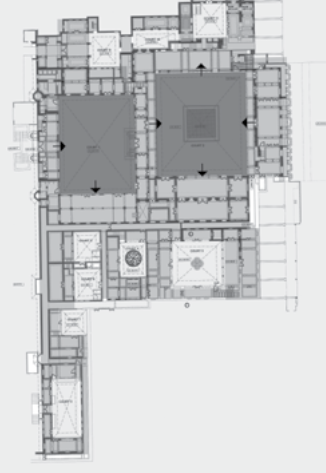
In Hawa mahal complex courtyards at various levels have a single storey construction on west and double storey on east side. The other two sides have tall walls forming the shape of a valley. These features help trap the westerly wind, and deflect it downwards. This process augments flow of wind through the openings on eastern side of the courtyard.
The Hawa Mahal has 953 small Jharokhas (covered windows) which allow view towards the outside and enhance ventilation inside the building through their position and shape (jails are set at an angle maximizing wind flow according to Bernoulli-Venturi principle
The maximum small openings are given at the East facing side (176 small windows), where the galleries are located, to capture the prevailing wind all year round, but especially in summer when the prevalent wind pattern is East to South East. All the main rooms are oriented towards the North side with small openings but attached to verandas and courtyards through archways and porticoes.
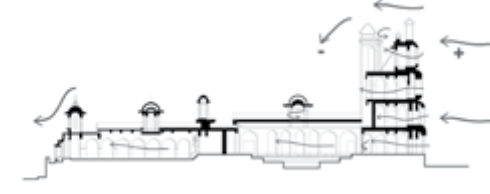
Section of the Hawa Mahal showing wind patterns for East prevailing
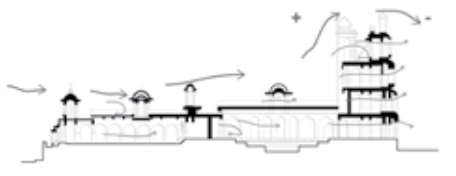
Section of the Hawa Mahal showing wind patterns for West prevailing
Home page : Jaipur – UNESCO World Heritage City
The Chowkris – The Wards of Jaipur | The Mohallas – Life Within the Wards | Jal Mahal and Ishvar Lat Jaipur | Jaipur Heritage Walk
Reference: Building Jaipur : the making of an Indian city by Sachdev, Vibhuti
Analysis Of Natural Ventilation Systems In Heritage Buildings: A Case Study Of Hawa Mahal, Jaipur India by Ioana Gabriela Simion , Prof (Dr) Madhura A Yadav
Disclaimer
Information on this site is purely for education purpose. The materials used and displayed on the Sites, including text, photographs, graphics, illustrations and artwork, video, music and sound, and names, logos, IS Codes, are copyrighted items of respective owner. Front Desk is not responsible and liable for information shared above.