

Collection of wet, dry and domestic hazardous waste separately ensures maximum recovery of recyclables.
Waste collection services are divided into primary and secondary collection.
Primary collection refers to the process of collecting, lifting and removal of segregated solid waste from source of its generation including households, shops, offices, markets, hotels, institutions and other residential or non-residential premises and taking the waste to a storage depot or transfer station or directly to the disposal site, depending on the size of the city and the waste management system prevalent in the city. Primary collection must ensure separate collection of certain waste streams or fractions depending on the separation and reuse system applied by the respective town or city
Secondary collection includes picking up waste from community bins, waste storage depots, or transfer stations and transporting it to waste processing sites or to the final disposal site. At the secondary collection points, segregated waste must be stored on-site in separate covered bins or containers for further collection and should be kept separate during all steps of waste collection, transportation, and processing. Further, ULBs should ensure that at the secondary storage points the waste is should be attended daily or before container starts overflowing.
Urban Infrastructure and Network Study notes for M. plan Sem-III

Urban Infrastructures & Network.pdf
Register as member and login to download attachment [pdf] by right-click the pdf link and Select “Save link as” use for Educational Purposes Only
Information on this site is purely for education purpose. The materials used and displayed on the Sites, including text, photographs, graphics, illustrations and artwork, video, music and sound, and names, logos, IS Codes, are copyrighted items of respective owners. Front Desk is not responsible and liable for information shared above.
Design considerations:
A. Engineering
B. Environmental
C. Process
D. Cost
A. Engineering Considerations ( Para 1.3.1 of CPHEEO Manual)
Topographical, engineering and other considerations which figure prominently in project design are noted below:
1. Design period, stage wise population to be served and expected sewage flow and fluctuations
2. Topography of general area to be served, its slope and terrain. Tentative sites available for treatment plant, pumping stations and disposal works
3. Available hydraulic head in the system up to high flood level in case of disposal to a nearby river or high tide level in case of coastal discharge or the level of the irrigation are to be commanded in case of land disposal
4.Ground water depth and its seasonal fluctuation affecting construction, sewer infiltration, structural design (uplift considerations) 5.Soil bearing capacity and type of strata expected to be met in construction 6.On site disposal facilities, including the possibilities of segregating the sullage water and sewage and reuse or recycle sullage water within the households
B Environmental Considerations: (Para 1.3.2 of CPHEEO Manual)
The environmental and socio-economic impacts of a sewage treatment plant may prove adverse during the operation stage. Therefore the following aspects should be considered during design.
i)Surface water Hydrology and Quality
ii)Ground water quality
iii)Coastal water quality
iv)Odour and Mosquito nuisance
v)Public Health and
vi)Landscaping
C. Process Considerations: ( Para 1.3.3 of CPHEEO Manual)
Process considerations involve factors which affect the choice of treatment method, its design criteria and related requirements such as the following: i)Waste water flow and characteristics ii)Degree of treatment required iii)Performance characteristics iv)Other process requirements such as land, power operating equipments, skilled staff, nature of maintenance problems, extent of sludge production and its disposal requirements, loss of head through plant in relation to available head etc.
D. Cost Considerations: ( Para 1.3.4 of CPHEEO Manual)
The overall costs (Capital and operating) have to be determined in order to arrive at the most optimum solution
Urban Infrastructure and Network Study notes for M. plan Sem-III
Urban Infrastructures & Network.pdf
Register as member and login to download attachment [pdf] by right-click the pdf link and Select “Save link as” use for Educational Purposes Only
Information on this site is purely for education purpose. The materials used and displayed on the Sites, including text, photographs, graphics, illustrations and artwork, video, music and sound, and names, logos, IS Codes, are copyrighted items of respective owners. Front Desk is not responsible and liable for information shared above.
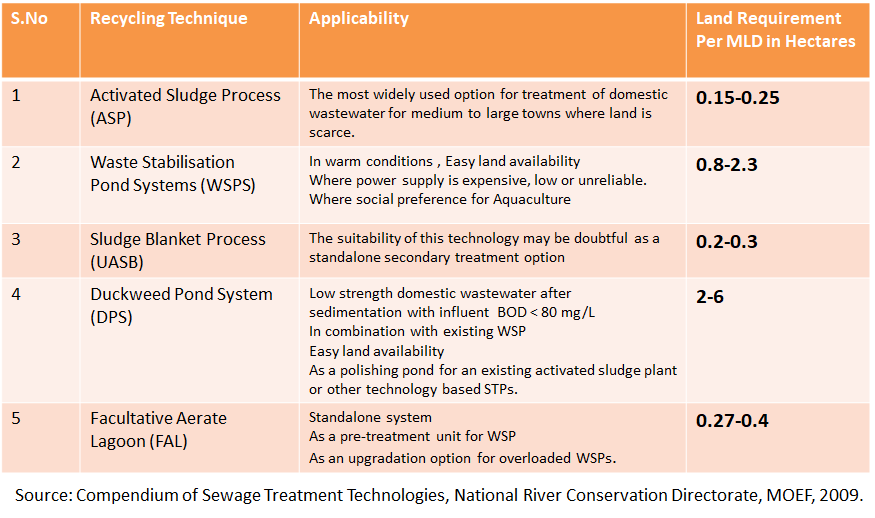
Land area required for various treatment technologies are shown in Figure . It can be observed that excluding WSP the land area is in the range of 0.2 to 1.0 hectare per MLD for STP as per the technology adopted keeping in view the size of the town / area.
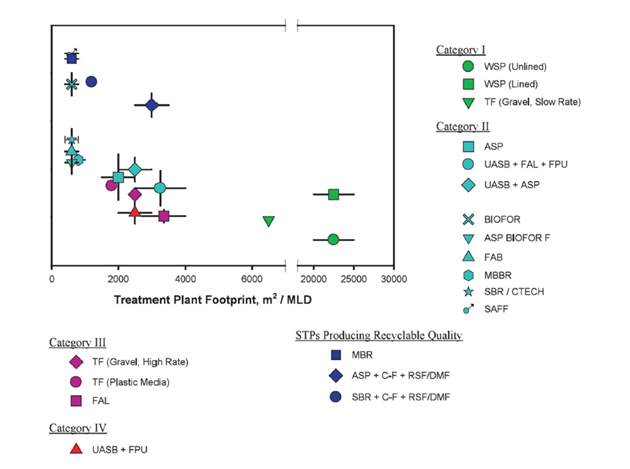
STP Land Area required for various treatment technologies
Source: NRCD, MoEF, 2009
Urban Infrastructure and Network Study notes for M. plan Sem-III
Urban Infrastructures & Network.pdf
Register as member and login to download attachment [pdf] by right-click the pdf link and Select “Save link as” use for Educational Purposes Only
Information on this site is purely for education purpose. The materials used and displayed on the Sites, including text, photographs, graphics, illustrations and artwork, video, music and sound, and names, logos, IS Codes, are copyrighted items of respective owners. Front Desk is not responsible and liable for information shared above.