

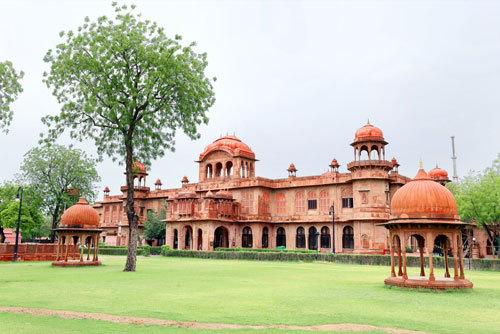
When Maharaja Ganga Singh of Bikaner decided to build a new residence at the turn of the 20th century, he was not seeking to replace the mighty Junagadh Fort, his ancestors’ stronghold. Instead, he wanted something different: a modern, comfortable retreat that reflected both his Rajput heritage and his global outlook. The result was Lallgarh Palace, one of Rajasthan’s finest Indo-Saracenic landmarks.
A Palace Built in Stages
Unlike many princely palaces, Lallgarh was not completed at once. Its four wings, framing a central charbagh-style garden, were constructed over nearly twenty-five years.
- The first wing was ready in 1903.
- The second followed in 1912.
- The final two wings were completed only in 1924–26.
This piecemeal construction reflected Ganga Singh’s evolving vision as he grew into his role as ruler. At the same time, he was also expanding Junagadh Fort, adding grand halls like the Darbar Hall (where his Golden Jubilee was celebrated in 1937). Junagadh remained the public and ceremonial heart of his reign, while Lallgarh served as his private residence and retreat.
Indo-Saracenic, but Uniquely Bikaneri
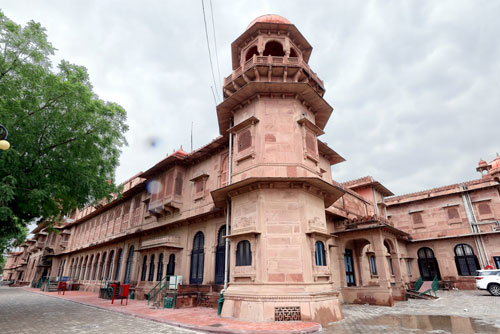
The design of Lallgarh came from Colonel Swinton Jacob’s office in Jaipur, which by then had become the most sought-after architectural practice in princely India. Jacob’s team followed their standard method: working hand-in-hand with local builders and craftsmen.
This collaboration gave Lallgarh a very different character from many Indo-Saracenic palaces in India. Rather than an eclectic mix of borrowed motifs, its detailing followed a true Bikaneri idiom, closely reminiscent of the courtyards and ornamentation of Junagadh Fort.
At the same time, its layout owed much to Western models. The rooms were generously proportioned—spacious, airy, and designed for a new lifestyle. Unlike the intimate chambers and narrow galleries of older forts, Lallgarh reflected the changing function of palaces in the modern age: less fortress, more home.
Tradition Meets Modernity
Even though Jacob himself did not consciously apply the principles of Vastu Vidya, the palace still absorbed elements of indigenous planning. Features like verandas linking ranges to internal courtyards reflected the living traditions of Rajput architecture. Lallgarh was, in essence, a fusion of East and West, yet deeply rooted in the soil of Bikaner.
In Contrast: Jacob’s Work for the British Raj
Interestingly, while Jacob’s office was designing masterpieces like Lallgarh for Indian princes, it was also working on projects for the imperial government. These commissions—such as the Senate House of the University of Allahabad (1887), St. Stephen’s College in Delhi (1894), the State Bank of Madras (1895), and the Secretariat in Simla (1901)—followed a very different approach.
Unlike in princely states, Jacob’s team could not involve local craftsmen when working for the British. The results were therefore more conventional, even pedestrian, examples of the Indo-Saracenic style, or in some cases (like the Simla Secretariat) entirely European in character, adopting a Scottish baronial style to match the Viceregal Lodge.
A Palace with a Purpose
Lallgarh thus stands apart—not just from the works of British architects like Mant and Chisholm, but also from Jacob’s own government projects. It was a palace with a personal purpose: a place where Maharaja Ganga Singh could live in comfort, entertain dignitaries, and embody his identity as both a Rajput warrior king and a modern statesman of global stature.
Jeypore portfolio of architecture details : Part-1 Coping and Plinths
Plate 1 | Plate 2 | Plate 3 | Plate 4 | Plate 5 | Plate 6 | Plate 7 | Plate 8 | Plate 9 | Plate 10 | Plate 11 | Plate 12 | Plate 13 | Plate 14 | Plate 15 | Plate 16 | Plate 17 | Plate 18 | Plate 19 | Plate 20 | Plate 21 | Plate 22 | Plate 23