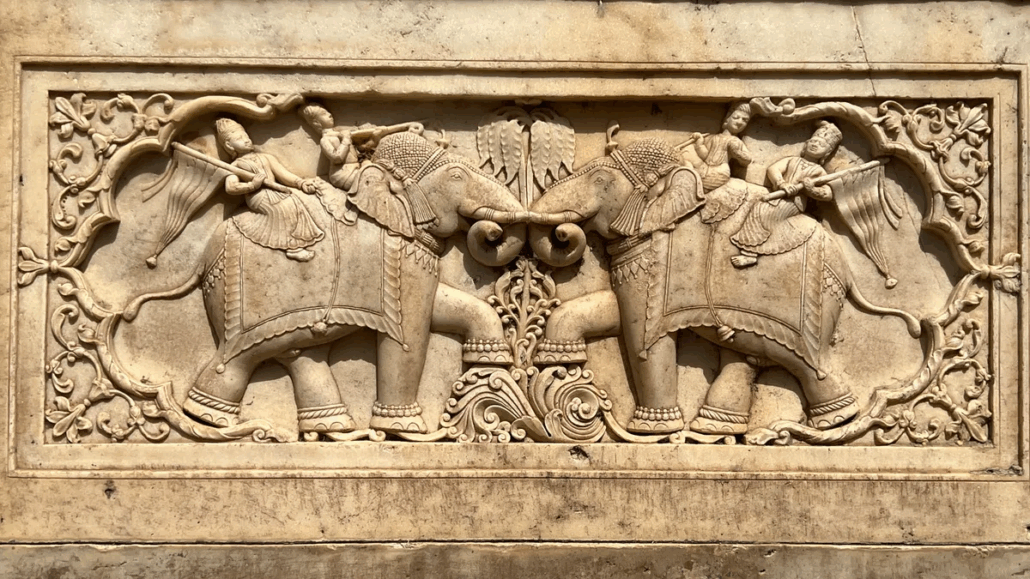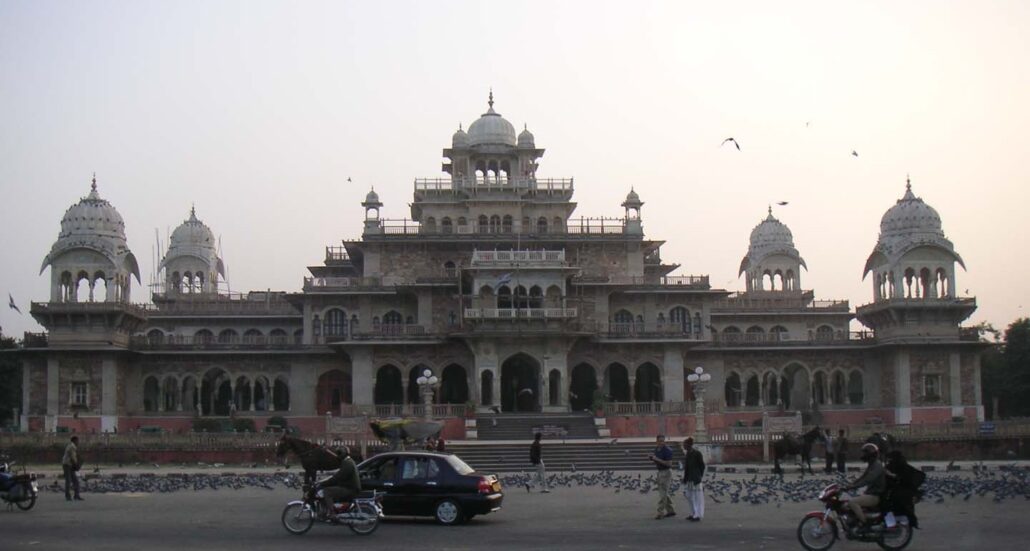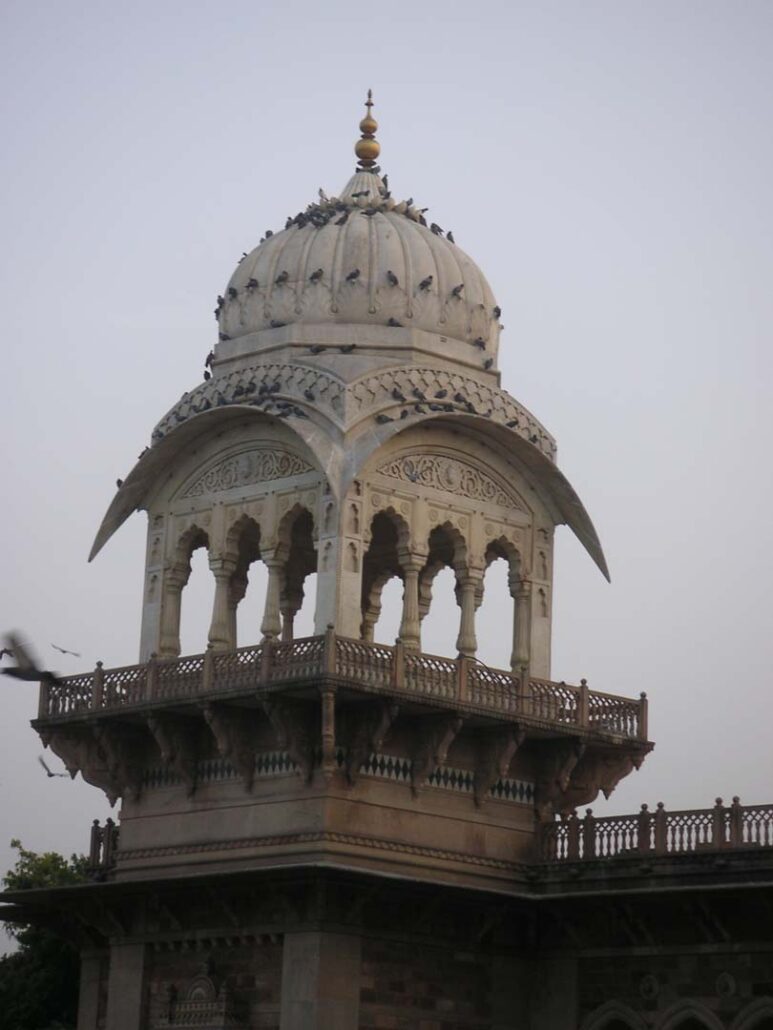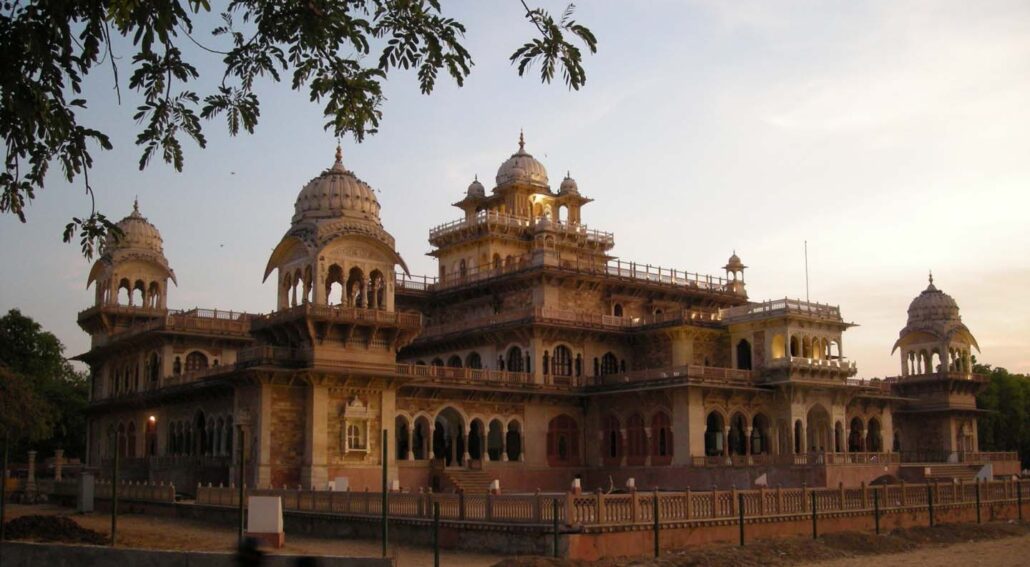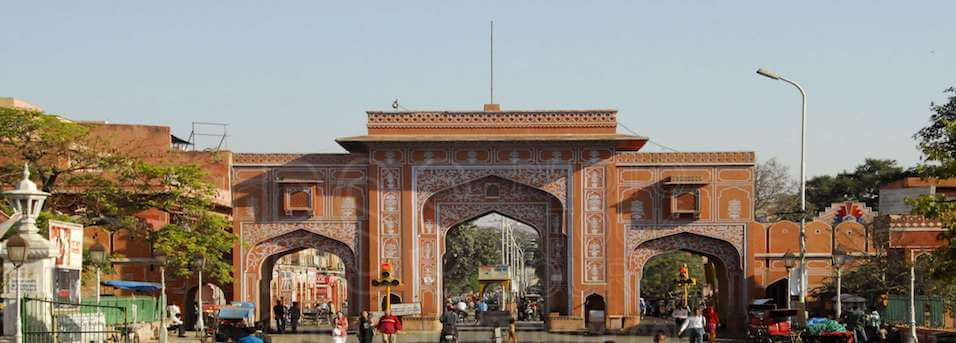

A substantial addition to the Jaipur palace complex was made in 1900 under the guidance of Chiman Lal, a distinguished architect trained in the Jaipur Public Works Department. This new structure, the Mubarak Mahal, stands as a unique testament to the transitional phase between traditional Indian design systems and the growing influence of modern architectural methods.
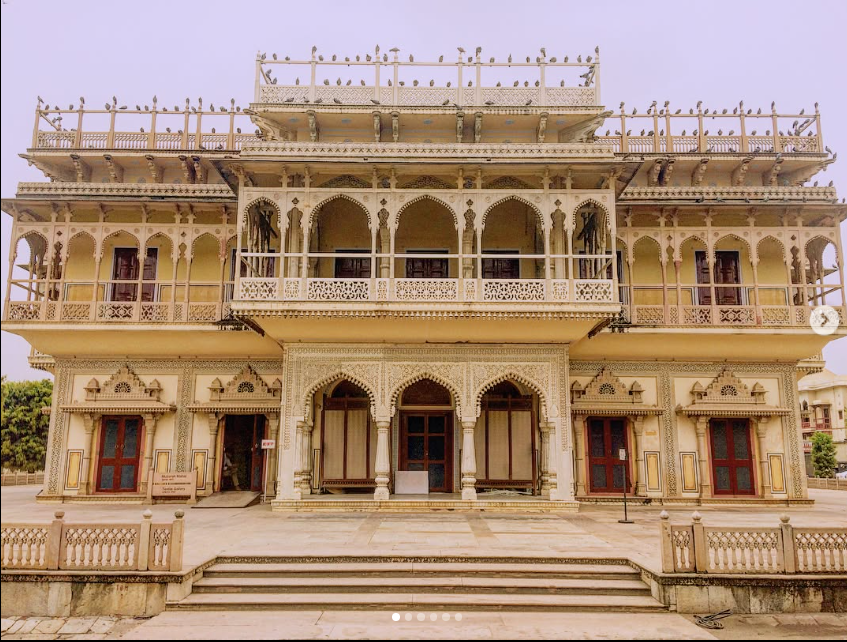
A Palace Within a Palace
The Mubarak Mahal is located immediately south of the main palace buildings, standing on a low podium at the heart of a spacious courtyard. It is connected to the Diwan-i-Khas by a gate now known as the Rajendra Pol, which was designed as part of the same scheme. Originally, this gate bore the name Sarhad ki Deori or “boundary door,” suggesting that the courtyard of the Mubarak Mahal lay outside the palace’s most sacred inner domains.
The gate’s glittering brass doors, constructed at the then-considerable cost of Rs. 11,000, symbolized both grandeur and privacy, shielding the royal family’s inner world. This strongly supports the widely held belief that the Mubarak Mahal was originally designed as a reception hall for guests who were not permitted into the main palace.
Changing Roles Through Time
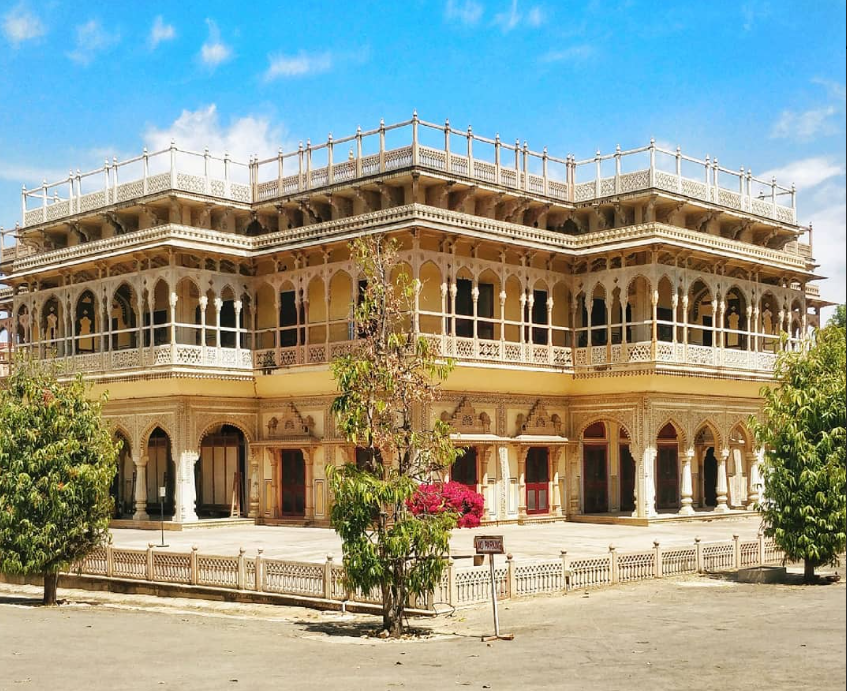
By the 1930s, the Mubarak Mahal had shifted from being a semi-public reception space to housing the Mahakma Khas, or Council of State. Today, it forms part of the City Palace Museum, allowing visitors to admire its architecture alongside curated displays of Jaipur’s royal heritage.
Architectural Brilliance
The design of the Mubarak Mahal follows the traditional sarvatobhadra type, a building form with a square plan and openings at the center of each side. Its planning is based on a mandalic grid — a perfect 3×3 arrangement that subdivides the building into nine equal sections.
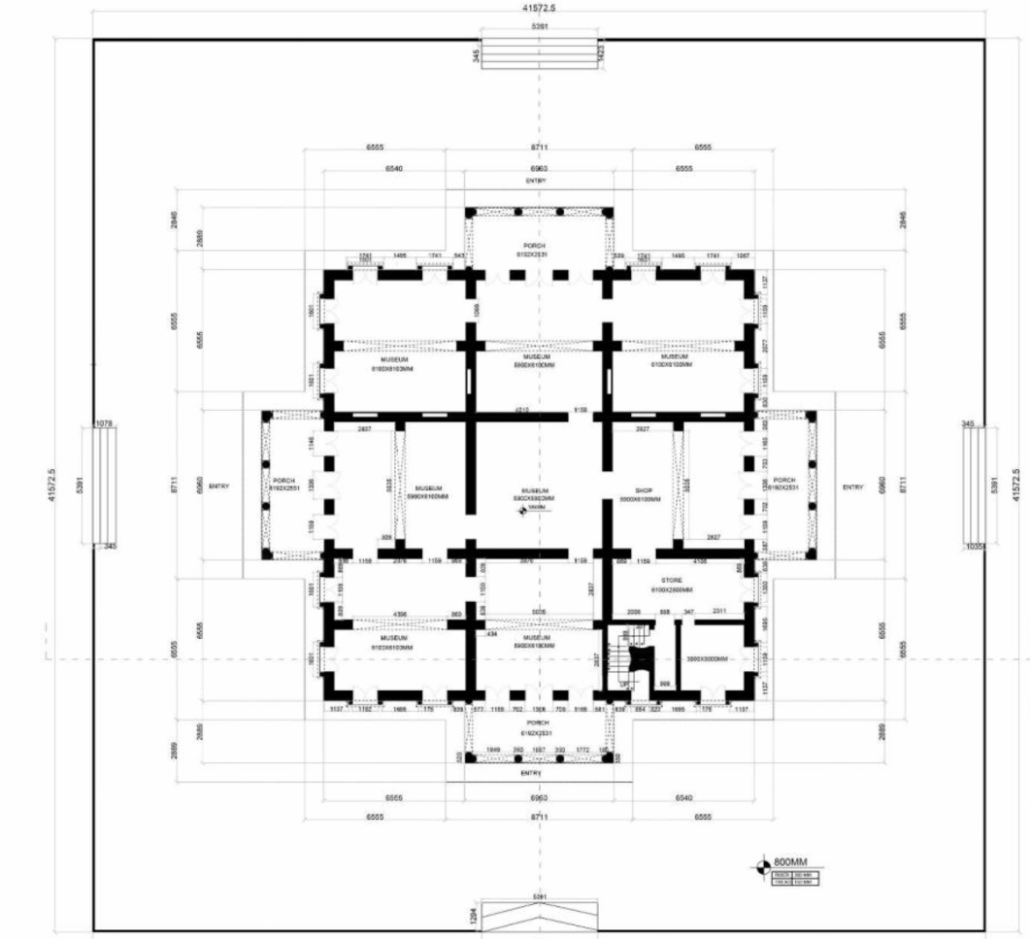
At the core of this plan lies an internal courtyard, rising through both storeys as a double-height hall. Surrounding rooms on the upper floor look inward through windows, much like the galleries around a haveli courtyard. This interplay between openness and enclosure exemplifies both aesthetic elegance and spatial intelligence.
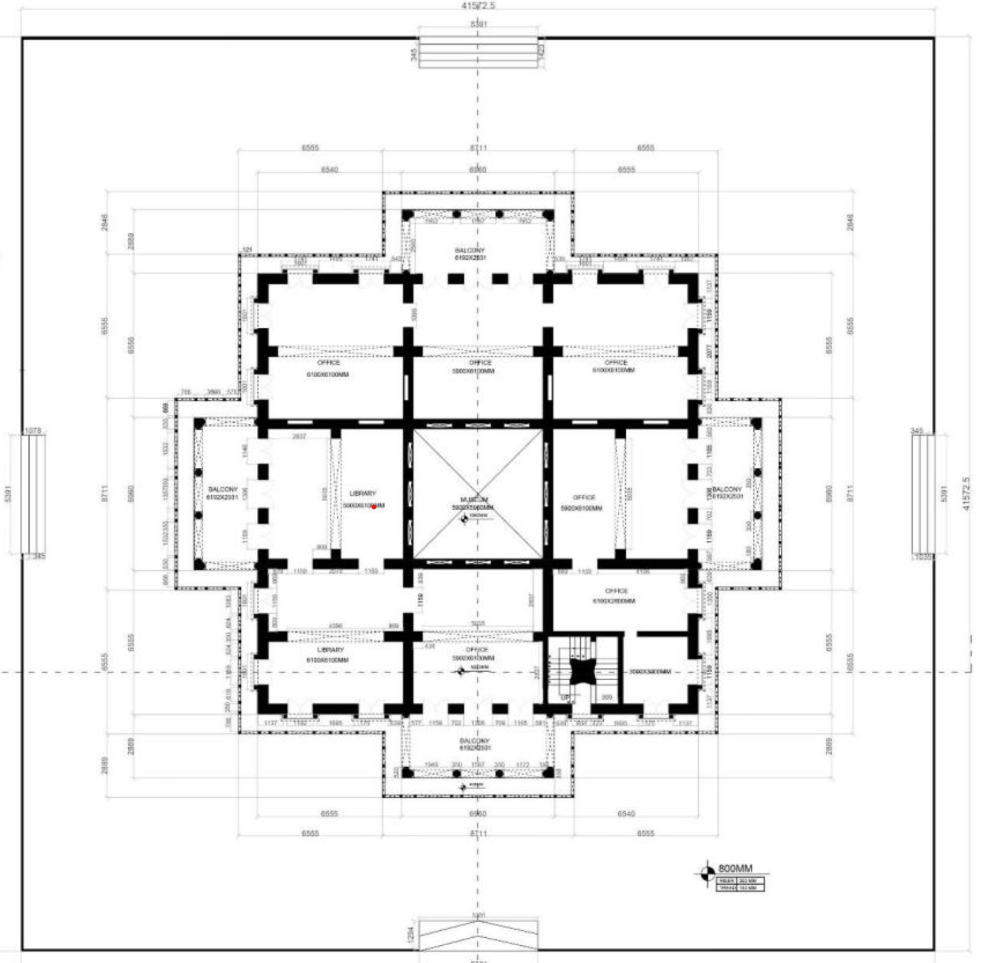
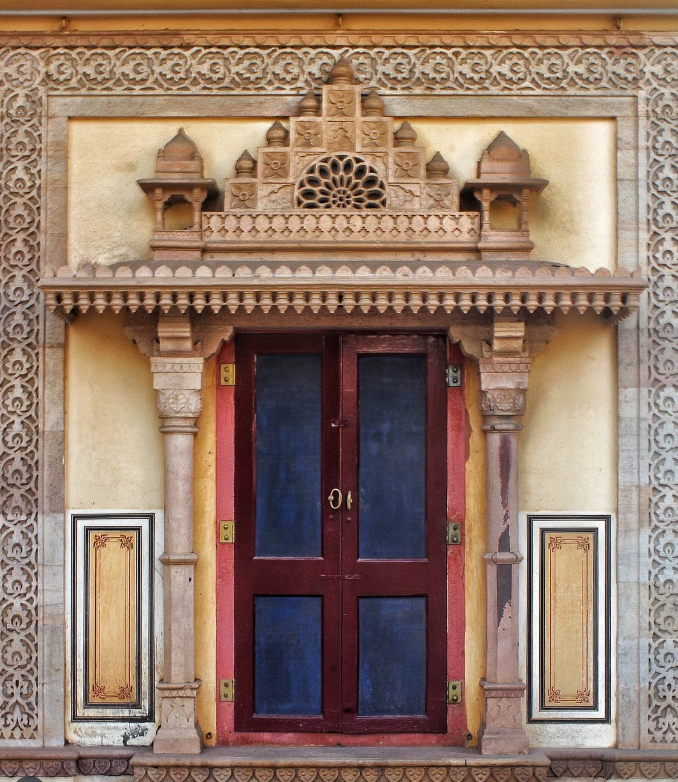
The verandas and projecting balconies highlight the central openings, while fine stonework and ornamental details showcase craftsmanship of the highest order. The richness of execution even surpasses earlier masterpieces such as the Albert Hall Museum, another landmark of Jaipur’s architectural evolution.
Between Tradition and Modernity
The Mubarak Mahal is particularly fascinating because it straddles two worlds. On one hand, it embodies the vastu vidya system — India’s ancient architectural science — applied with geometric clarity. On the other, it reflects the influence of British-style drawing office precision, instilled through the training of Chiman Lal and his peers under Colonel Sir Samuel Swinton Jacob.
Here, design is less the product of intuitive, on-site practice and more the outcome of carefully drafted plans. Ornamentation was often sketched on stone by draftsmen and then executed by stone-cutters — a separation of design and craft that signals a modern shift in building traditions.
A Living Monument to Change
The Mubarak Mahal is more than just an exquisite little palace. It represents a turning point — a moment when Jaipur’s architectural traditions were no longer entirely “living,” but also archaeological in spirit, preserved with academic precision rather than evolving organically through practice.
And yet, its beauty is undeniable. Walking through its spaces, one experiences both the continuity of India’s architectural heritage and the subtle presence of modernity shaping it. The Mubarak Mahal thus remains a jewel of the City Palace complex, symbolizing Jaipur’s transition into the 20th century.
Key Architectural & Historical Points
- Mubarak Mahal (1900)
- Location & function: A new addition to the City Palace, set in its own courtyard south of the main palace and separated by the Rajendra Pol (Sarhad ki Deori).
- Originally intended as a reception hall for “outsiders” (those not allowed into the royal inner court).
- Later became the Mahakma Khas offices (Council of State) and today is part of the City Palace Museum.
- Design features
- Sarvatobhadra type (a square building with openings on all four sides), following traditional palace typology.
- 3×3 grid (mandala plan): Square subdivided geometrically with nine equal sections.
- Central void: The middle bay left open, forming a double-height hall, around which upper rooms open inward with windows, resembling a courtyard turned vertical.
- Craftsmanship: Exceptional details in balconies, verandas, doors (notably the brass doors of Rajendra Pol, costing Rs 11,000).
- Stylistic Significance
- On the surface, the Mahal looks like a triumph of vastu vidya (traditional Indian design principles).
- But the passage argues it is not fully “organic” vastu:
- The geometric precision reflects drawing-office methods (measured drawings, draftsmen, sketches).
- Traditional Indian design often evolved on site with rules, proportions, and craftsman improvisation. Here, everything was pre-calculated and codified.
- Craftsmanship vs. design process: Ornamentation was “sketched for the stonecutters” by draftsmen, separating the role of designer and artisan. Traditionally, master masons did both.
- Interpretation
- The building represents the hybrid outcome of Jacob’s legacy:
- Chiman Lal, trained under Jacob, produced something Indian in form but European in method.
- The Jaipur Portfolio (Jacob’s publication of Indian decorative motifs) became the reference rather than a living tradition.
- Hence, the Mubarak Mahal shows the transformation of vastu vidya: not dead, but altered by colonial encounter.
- The building is exquisite but has an “archaeological” quality – a preservation and stylization of tradition rather than its free continuation.
- The building represents the hybrid outcome of Jacob’s legacy:
Echoes of Transition: Jacob’s Legacy and the Raj Imarat’s Architectural Journey
Home page : Jaipur – UNESCO World Heritage City
The Chowkris – The Wards of Jaipur | The Mohallas – Life Within the Wards | Jal Mahal and Ishvar Lat Jaipur | Hawa Mahal – The Palace of Winds | Jaipur Heritage Walk | Important Bazar | Chowkri Modikhana | Chowkri Vishveshwarji
Jeypore portfolio of architecture details : Part-1 Coping and Plinths
Plate 1 | Plate 2 | Plate 3 | Plate 4 | Plate 5 | Plate 6 | Plate 7 | Plate 8 | Plate 9 | Plate 10 | Plate 11 | Plate 12 | Plate 13 | Plate 14 | Plate 15 | Plate 16 | Plate 17 | Plate 18 | Plate 19 | Plate 20 | Plate 21 | Plate 22 | Plate 23