
Jaipur – UNESCO World Heritage City
While Sawai Jai Singh II laid Jaipur’s foundations, the city’s architectural story did not end with him. His successors in the 18th century extended his vision with new palaces, monuments, and structures—each adding to Jaipur’s grandeur and symbolism.
Jal Mahal – The Water Palace
Standing serenely in the middle of Man Sagar Lake, on the road to Amber, the Jal Mahal (Water Palace) is among Jaipur’s most iconic landmarks. Though sometimes dated as late as 1779, palace records and surviving drawings suggest it was likely constructed during Sawai Jai Singh’s reign, around 1714, soon after Jaipur’s foundation.
Jal Mahal served as a pleasure resort, where the king and his retinue could enjoy the coolness of the lake and the beauty of its surroundings. Its design continues a Rajput tradition of water palaces, echoing the Palace of Padmini at Chittor (14th century) and Udaipur’s island palaces such as Jag Mandir (1630) and Jag Niwas (1734). Its delicate architecture, blending Rajput and Mughal styles, seems to float over the shimmering lake—a perfect retreat from the desert heat.
Ishvar Lat – The Tower of Victory
Sawai Jai Singh passed away in 1743, leaving his eldest son Ishvari Singh as heir. His reign, however, was marred by a bitter succession dispute with his half-brother Madho Singh, backed by Udaipur, Bundi, and Maratha allies.
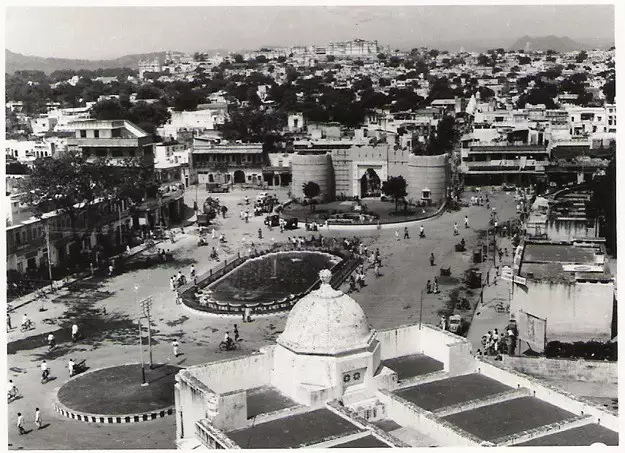
In 1749, after defeating his rivals, Ishvari Singh erected the Ishvar Lat, a tall and elegant tower on the southern edge of the palace complex. This “Victory Tower” proclaimed his triumph over the pretender. Rising prominently above Jaipur’s skyline, it was a symbolic statement of legitimacy and power.
Yet Ishvari Singh’s victory proved short-lived. The unrelenting conflict and political pressure demoralized him, and in 1750 he took his own life, clearing the way for Madho Singh’s rule (1751–1768). Jaipur’s citizens later spun a more romantic tale—that the tower had been built so Ishvari Singh could secretly watch a beauty bathing nearby. But its true origin remains rooted in political rivalry and assertion of authority.
Hawa Mahal – The Palace of Winds
Principles of Vastu Vidya
Far from being accidental, the entire composition demonstrates the application of universal design principles of Indian architecture:
- Tripartite division (centre and flanks)
- Subdivision of the wider centre
- Framing and grouping of motifs
- Repetition with variation
- Integration of parts into a harmonious whole
Thus, the Hawa Mahal is not an eccentric flourish but a rigorously ordered creation—one possible outcome of applying vastu vidya. Its elegance lies in how these age-old principles were translated into a living, breathing urban monument.
From the Jal Mahal’s tranquil waters to the towering Ishvar Lat and the breathtaking Hawa Mahal, these later additions enriched Jaipur’s skyline and deepened its symbolic identity. They also demonstrate how successive rulers—despite political turmoil—continued to uphold and extend the architectural vision of their illustrious founder.
In this sense, the Hawa Mahal is more than a palace façade. It is a textbook of Indian compositional order, a visual hymn to proportion, rhythm, and harmony—proof that Jaipur’s architecture is as intellectual as it is beautiful.
Home page : Jaipur – UNESCO World Heritage City
The Chowkris – The Wards of Jaipur |The Mohallas – Life Within the Wards | Hawa Mahal – The Palace of Winds | Jaipur Heritage Walk
Reference: Building Jaipur : the making of an Indian city by Sachdev, Vibhuti
Disclaimer
Information on this site is purely for education purpose. The materials used and displayed on the Sites, including text, photographs, graphics, illustrations and artwork, video, music and sound, and names, logos, IS Codes, are copyrighted items of respective owner. Front Desk is not responsible and liable for information shared above.