
Jaipur’s Artistic Resurgence: From the 1883 Exhibition to the Albert Hall Museum
Samuel Swinton Jacob and the Making of Jaipur’s Albert Hall Museum
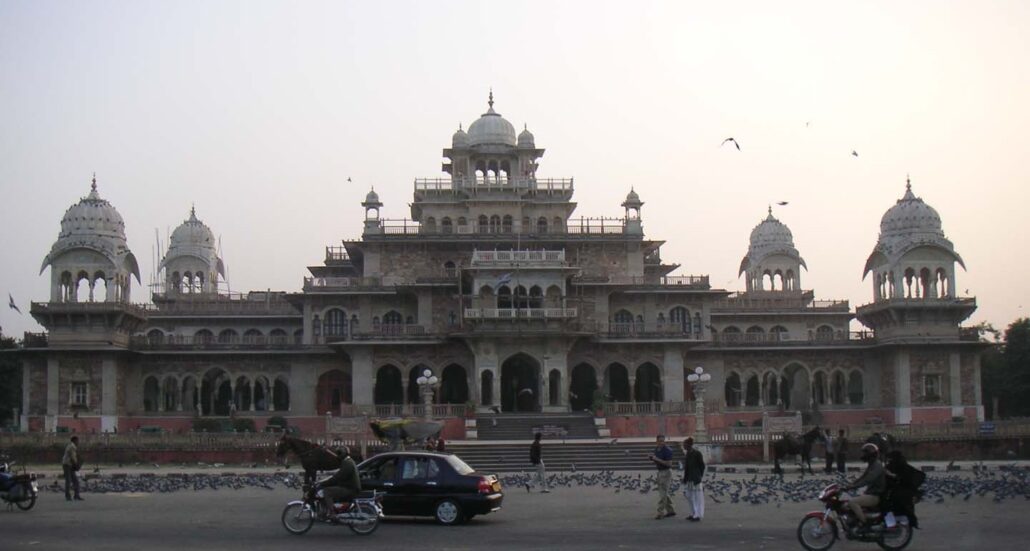
When the Albert Hall Museum was formally opened in 1887, it was conceived not merely as a gallery of objects but as a didactic institution—a place of instruction as much as of display. The museum remained open to visitors of every class, free of charge, between dawn and dusk, embodying the progressive vision of public education in late 19th-century Jaipur.
Its origins lay in the Exhibition of 1883, a vast display of arts, crafts, and industries from Jaipur and neighboring states. Many of the objects shown there were eventually given a permanent home within the new museum, while others were purchased outright. The collection had a dual purpose: to inform the wider public about India’s rich heritage, and to serve as models for craftsmen, thereby sustaining traditional skills.
Education with Guidance
The museum’s educational mission was carefully curated. As Dr. Hendley, Jacob’s collaborator, noted, European objects were occasionally acquired—but only for comparative purposes. Local artisans could freely borrow good specimens of Indian workmanship for reproduction, but they were forbidden from copying European designs. This ensured that the museum promoted continuity of indigenous traditions rather than diluting them with imported styles.
The Building as a Museum in Itself
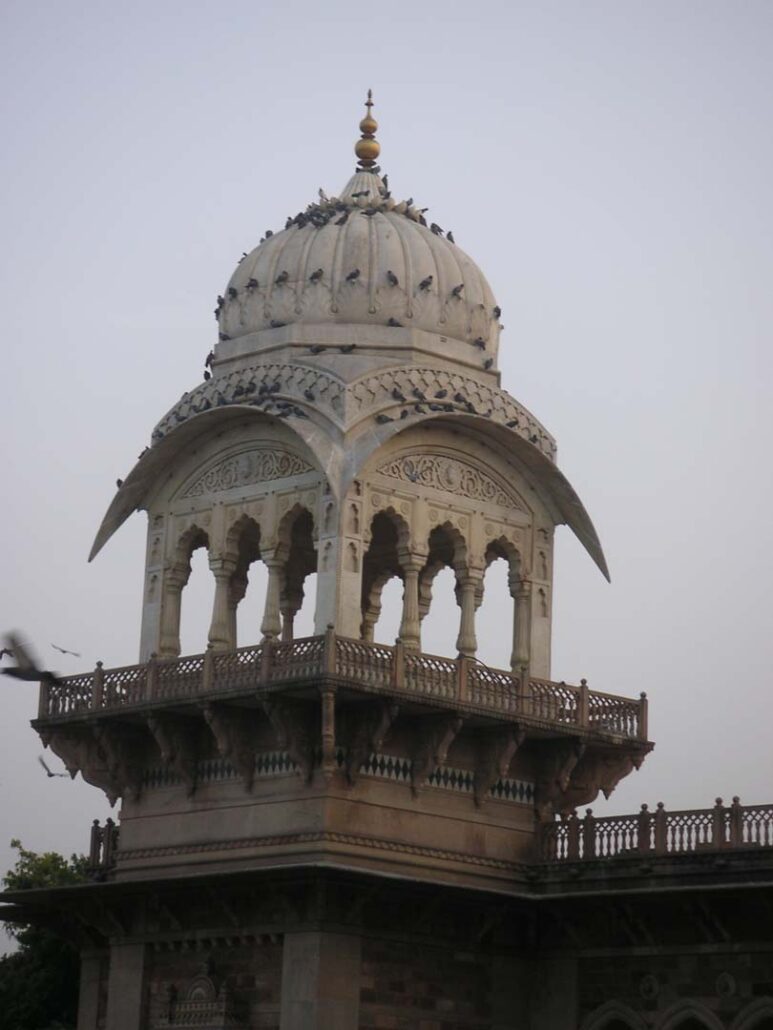
What set the Albert Hall apart was that its very fabric was part of its educational mission. Jacob declared that his aim was to make “the walls themselves a Museum,” borrowing patterns and motifs from historic monuments in Delhi, Agra, and Jaipur. Rather than relegating craftsmanship to the objects inside, the building itself became an embodied portfolio of architectural details.
Hendley emphasized that Jaipur was already celebrated for its exquisite stone carving, so Jacob deliberately made this the hallmark of the museum’s design. Instead of duplicating the same art within the galleries, he directed visitors’ attention to the building’s own richly carved surfaces.
A Three-Dimensional Jeypore Portfolio
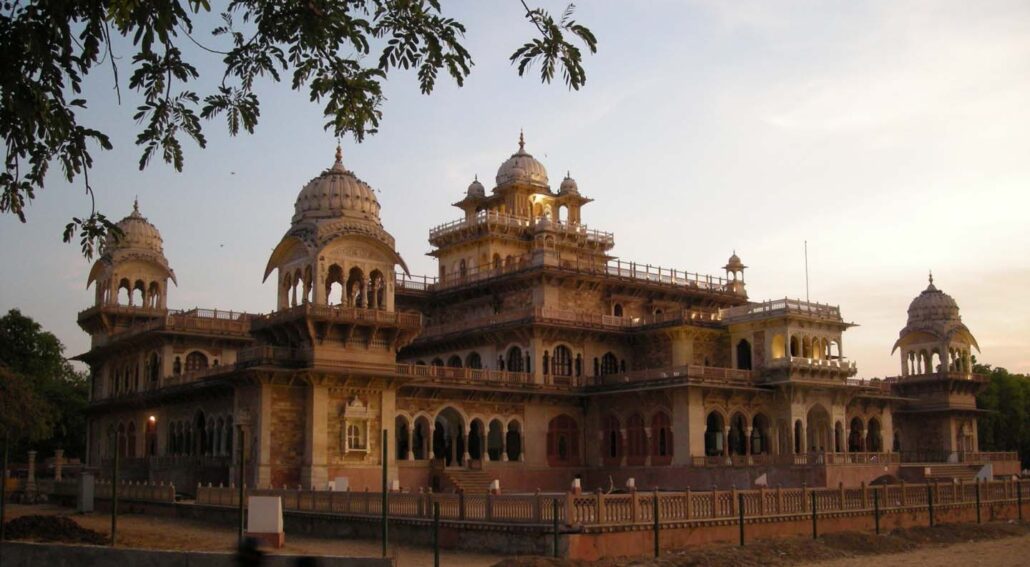
In this sense, the Albert Hall Museum acted as a three-dimensional counterpart to the Jeypore Portfolio of Architectural Details. Whereas the Portfolio recorded and disseminated drawings of India’s architectural ornament, Albert Hall presented them in stone, plaster, and marble for all to see. Visitors could walk through an architectural encyclopedia—each bracket, cornice, column, and arch exemplifying centuries of North Indian artistry.
Yet, as modern scholars note, this process also fragmented a formerly cohesive tradition. By isolating decorative details from their larger architectural contexts, Jacob and Hendley turned motifs into specimens, teaching tools rather than integral parts of a living architectural language.
Thus, the Albert Hall Museum was not only a repository of art but also a pedagogical monument—a building designed to teach through its walls, shaping the perception of Indian craftsmanship for both artisans and the wider public.
The Public Works Department and the Rise of the Indo-Saracenic Movement
Style and Power: The Indo-Saracenic Debate in Colonial India
Agency and Architecture: Who Really Designed Indo-Saracenic India?
Home page : Jaipur – UNESCO World Heritage City
The Chowkris – The Wards of Jaipur | The Mohallas – Life Within the Wards | Jal Mahal and Ishvar Lat Jaipur | Hawa Mahal – The Palace of Winds | Jaipur Heritage Walk | Important Bazar | Chowkri Modikhana | Chowkri Vishveshwarji
Jeypore portfolio of architecture details : Part-1 Coping and Plinths
Plate 1 | Plate 2 | Plate 3 | Plate 4 | Plate 5 | Plate 6 | Plate 7 | Plate 8 | Plate 9 | Plate 10 | Plate 11 | Plate 12 | Plate 13 | Plate 14 | Plate 15 | Plate 16 | Plate 17 | Plate 18 | Plate 19 | Plate 20 | Plate 21 | Plate 22 | Plate 23
Reference: Building Jaipur : the making of an Indian city by Sachdev, Vibhuti
Disclaimer : Information on this site is purely for education purpose. The materials used and displayed on the Sites, including text, photographs, graphics, illustrations and artwork, video, music and sound, and names, logos, IS Codes, are copyrighted items of respective owner. Front Desk is not responsible and liable for information shared above.