
Sūtra 2.11 – samanaskāmanaskāḥ (समनस्कामनस्काः)
Word-split: samanaska (with mind) + amanaskāḥ (without mind)
Meaning: Worldly souls are of two kinds – with mind (samanaska) and without mind (amanaska).
Explanation:
- Samanaska (with mind, also called saini) – beings who have developed a mind (manas) and can think, imagine, or plan. Example: humans, animals, higher beings.
- Amanaska (without mind, also called asaini) – beings without developed mind, functioning only through senses. Example: one-sensed beings like plants, earth-bodies, water-bodies, etc.
Sūtra 2.12 – saṃsāriṇas trasasthāvarāḥ (संसारिणस्त्रसस्थावराः)
Sandhi-viccheda: saṃsāriṇaḥ + trasa + sthāvarāḥ
Meaning: Worldly souls (saṃsārī jīvas) are of two kinds – trasa (mobile) and sthāvara (immobile).
Explanation:
- Trasa (mobile beings):
- Beings that possess two to five senses (taste, smell, sight, hearing, touch).
- They can move independently, express fear, and are more evolved.
- Examples: worms, insects, birds, animals, humans, heavenly and hellish beings.
- Sthāvara (immobile beings):
- Beings that have only one sense – touch (sparśana-indriya).
- They are rooted or stationary in nature, unable to move voluntarily.
- Examples: earth-bodied, water-bodied, fire-bodied, air-bodied, and plant-bodied beings.
Thus, worldly souls are divided into mobile and immobile.
Sūtra 2.13 – pṛthivyaptejovāyuvanaspatayaḥ sthāvarāḥ (पृथिव्यप्तेजोवायुवनस्पतयः स्थावराः)
Sandhi-viccheda: pṛthivī + ap + tejaḥ + vāyu + vanaspatayaḥ + sthāvarāḥ
Meaning: Earth-bodied, water-bodied, fire-bodied, air-bodied, and plant-bodied are the five classes of immobile (sthāvara) beings.
Explanation:
The five types of sthāvara jīvas are:
- Pṛthivīkāyika (Earth-bodied beings): Their body is made of earth particles. Example: clay, stones, metals.
- Jalakāyika (Water-bodied beings): Their body is water. Example: natural water-bodies.
- Agnikāyika (Fire-bodied beings): Their body is fire/heat. Example: flames, sparks.
- Vāyukāyika (Air-bodied beings): Their body is air. Example: wind currents.
- Vanaspatikāyika (Plant-bodied beings): Their body is vegetation. Example: trees, plants, creepers.
Special Notes (Viśeṣa):
- In each case, the body of the living being is made of the corresponding substance – earth, water, fire, air, or plant matter.
- During vigraha-gati (soul’s travel from one birth to the next), when sthāvara nāma-karma comes into fruition, the soul unites with the corresponding matter (earth, water, etc.) and forms its body. When the lifespan ends, the soul departs, leaving the material body behind.
- Example: Pure water (hydrogen + oxygen) is lifeless matter. When a soul, through karmic rise, takes birth in it, it becomes a water-bodied living being (jalakāyika). When filtered, mobile (trasa) beings can be separated, but the microscopic water-bodied beings remain unseen. Boiling destroys them, and the remaining water becomes lifeless matter (ajīva pudgala).
- Definition: The specific state of a soul caused by the rise of sthāvara nāma-karma is called sthāvara.
- Maximum lifespans of sthāvara beings:
- Soft earth-bodied (mṛdu-pṛthivīkāyika) – 12,000 years
- Hard earth-bodied (khara-pṛthivīkāyika) – 22,000 years
- Water-bodied – 7,000 years
- Fire-bodied – 3 days
- Air-bodied – 3,000 years
- Plant-bodied – 10,000 years
Sūtra 2.14 – dvīndriyādayas trasāḥ (द्वीन्द्रियादयस्त्रसाः)
Sandhi-viccheda: dvīndriyāḥ + ādayaḥ + trasāḥ
Meaning: Starting with two-sensed beings, all (up to five-sensed beings) are called trasa (mobile beings).
Explanation:
- Mobile beings (trasa jīvas) are classified by the number of senses they possess.
- Dvīndriya (two-sensed beings): Touch + Taste
- Trīndriya (three-sensed beings): Touch + Taste + Smell
- Caturindriya (four-sensed beings): Touch + Taste + Smell + Sight
- Pañcendriya (five-sensed beings): All five senses (touch, taste, smell, sight, hearing).
Thus, beings from two-sensed to five-sensed are trasa jīvas.
Special note – Vikala-traya jīvas
- The beings from two-sensed up to four-sensed are called Vikala-traya jīvas (imperfect three groups), because they lack one or more senses compared to the complete set of five.
- Their maximum lifespans (utkṛṣṭa āyuḥ):
- Dvīndriya (two-sensed beings): e.g., shells, snails, worms, leeches → up to 12 years
- Trīndriya (three-sensed beings): e.g., ants, small insects → up to 49 days
- Caturindriya (four-sensed beings): e.g., bees, flies, moths → up to 6 months
- Pañcendriya (five-sensed beings): e.g., humans, cows, birds, animals.
- Their maximum lifespan can extend up to 33 sāgaropamas (in the 7th hell or in Sarvārthasiddhi heaven).
- The minimum lifespan can be as short as an antarmuhūrta (less than 48 minutes).
Sūtra 2.15 – pañcendriyāṇi (पञ्चेन्द्रियाणि)
Sandhi-viccheda: pañca + indriyāṇi
Meaning: There are five senses.
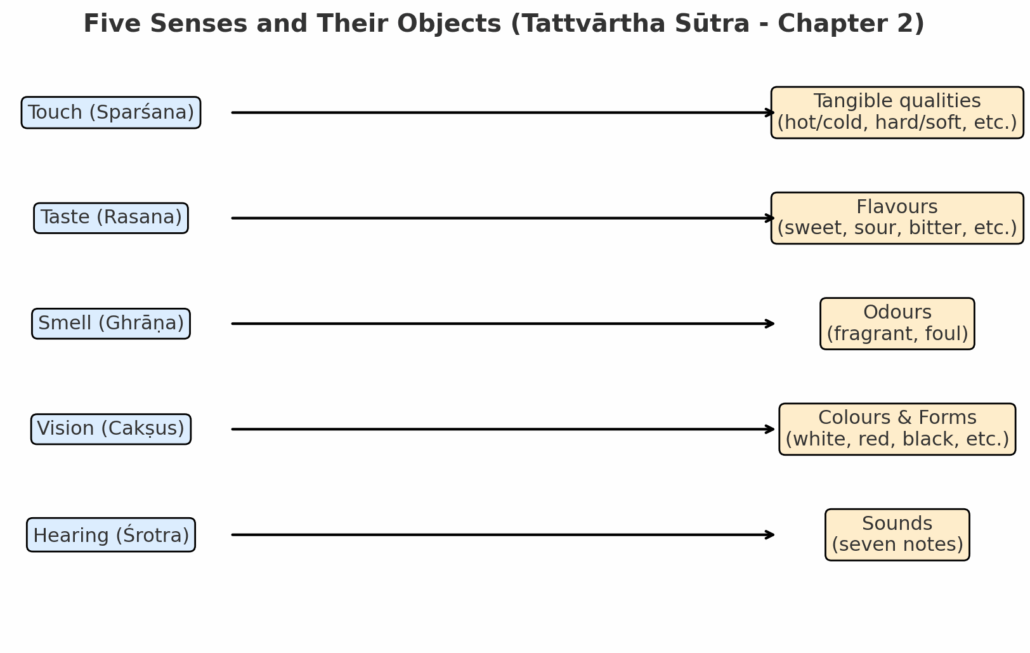
Explanation of the Five Senses (indriyas):
- Sparśanendriya (Touch)
- Rasanendriya (Taste)
- Ghrāṇendriya (Smell)
- Cakṣurindriya (Sight)
- Śrotrendriya (Hearing)
- These are the organs created in the body due to the rise of specific karmas (indriya-nāma karma, jāti-nāma karma, aṅgopāṅga-nāma karma).
- Each sense functions independently of the others, and each is specific to its own object (touch, taste, smell, form, sound).
Question: Why is the mind (manas) not counted as a sense?
- Answer: Because unlike the five senses, the mind is not located in any specific external organ of the body.
- Eyes, ears, nose, tongue, skin are external and rule-based. The mind, however, is internal and subtle.
- Hence, the mind is called anindriya (not an external sense), though it also channels the activity of the soul (upayoga).
Sutra 16 to 20
English explanation of Tattvarth Sutra
Chapter 1 – Sutra 1 to 5 | Sutra 6 to 12 | Sutra 13 to 19 | Sutra 20 to 25 | Sutra 26 to 31 | Sutra 32 and 33
Chapter 2– Sutra 1 to 5 | Sutra 6 to 10
Animations and Visualizations.
मुनि श्री 108 प्रणम्यसागरजी तत्वार्थ सूत्र with Animation